Why Traditional Size Charts Fail: The Mathematics of Garment Ease Explained
Explore why static size charts confuse 65% of online shoppers, how the math of "garment ease" actually works, and how AI engines calculate the perfect fit.
The Sizing Paradox: Why Clear Tables Still Cause 70% of Returns
Every fashion brand on Shopify has a size chart. Yet, across the e-commerce industry, over 70% of clothing returns are still blamed on "poor fit". How can both of these facts be true at the same time?
The answer lies in a fundamental communication disconnect between fashion designers and online shoppers: the hidden concept of Garment Ease.
Flat Garment Measurements vs. Body Dimensions
When a customer looks at a size chart that says "Medium – Chest 42 inches", what does that number actually represent?
- To the merchant/patternmaker: It means the finished fabric of the shirt measures 42 inches when laid flat on a table.
- To the customer: They assume it is intended for a human body whose chest perimeter measures 42 inches.
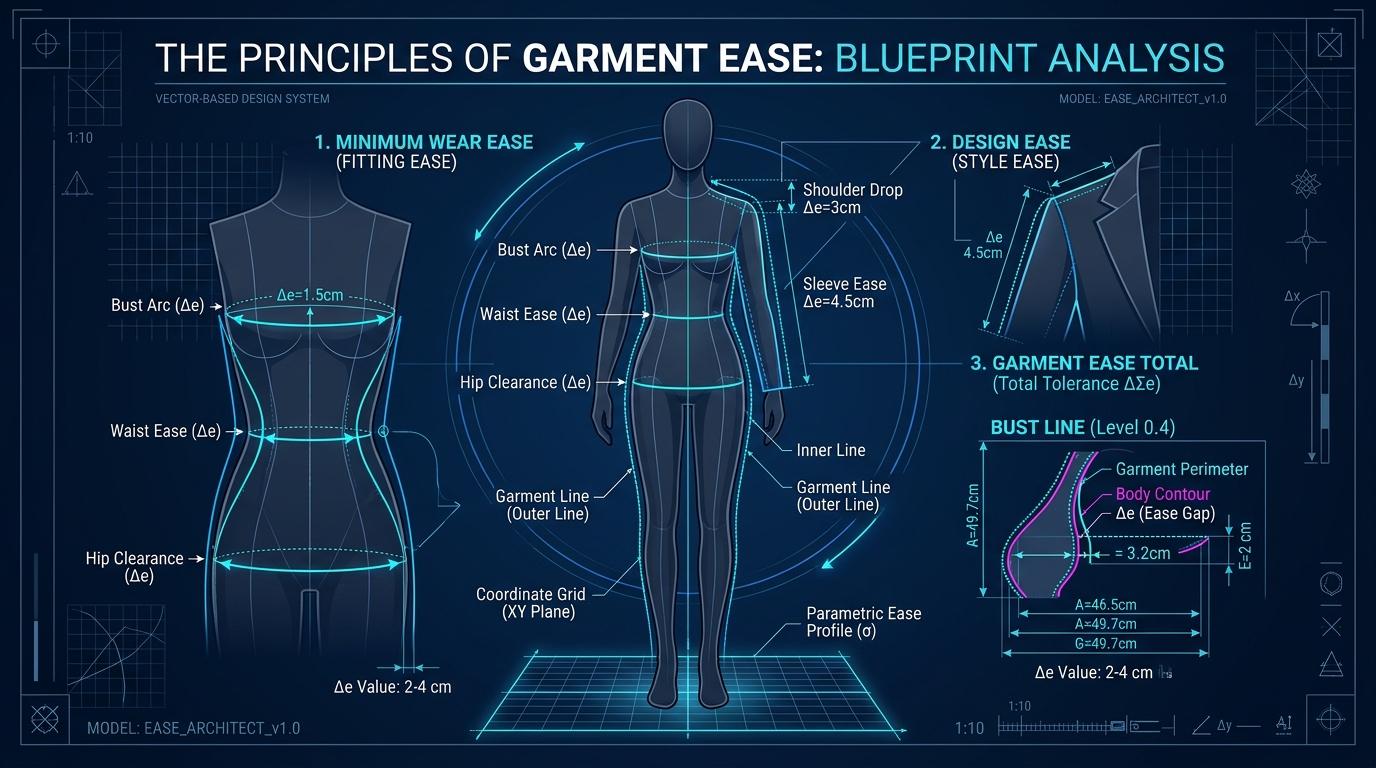
If a man with a 42-inch chest buys a 42-inch woven dress shirt, the shirt will be skin-tight and impossible to button comfortably. Humans need breathing and movement space inside their garments. That breathing room is Ease.
The Mathematical Formula of Ease
At its core, sizing recommendation is driven by a simple arithmetic balance:
Garment Finished Measurement − Customer Body Measurement = Ease
There are two distinct types of ease that every apparel merchant must understand:
- Wearing Ease (Comfort Floor): The mandatory clearance needed for standard movement—inhaling, sitting, bending elbows, and walking. For non-stretch woven fabrics, wearing ease is typically 2.0 to 3.0 inches around the chest and 1.5 to 2.0 inches around the hips.
- Design Ease (Stylistic Silhouette): The additional volume intentionally added by the designer to establish the garment silhouette (e.g., slim fit vs. relaxed fit vs. oversized streetwear hoodie with +8 inches of ease).
Positive Ease vs. Negative Ease
Not all clothing requires positive ease. Depending on fabric stretch and construction:
- Negative Ease (−1" to −4"): Used for activewear, compression gear, leggings, and swimwear. The garment is physically smaller than the human body and relies on elastane/spandex recovery to stretch comfortably.
- Standard Positive Ease (+2" to +4"): Essential for tailored shirts, blazers, trousers, and non-stretch dresses.
- Generous Positive Ease (+5" to +10"): Required for winter outerwear, wool trench coats, and oversized streetwear.
How AI Fit Scoring Automates the Math
Expecting shoppers to calculate ease manually is unrealistic. This is where EaseTrue's Smart Fit Engine comes in. In your EaseTrue dashboard, you define the target ease per measurement column once.
When a shopper enters their dimensions, the algorithm calculates the difference between actual garment ease and ideal target ease. If a measurement falls outside the comfort boundary, a fine-tuned penalty per inch is deducted, producing an instant confidence score out of 100.
Even better: if a customer's unique proportions fall below the acceptable ease threshold across all standard sizes, the engine seamlessly triggers the AI Fallback Bridge—inviting them to order a Custom Made-to-Measure size with their exact measurements.
Key Takeaway for Merchants
Stop treating size charts like flat static tables. By properly defining garment ease and letting predictive AI guide your buyers, you eliminate sizing ambiguity, boost conversion rates, and protect your margins from costly returns.